The $29 Sneaker With a Carbon Board That Keeps Surprising Me
I'll be straight with you — when this shoe first landed in our stockroom, I rolled my eyes a little. A carbon board shoe for twenty-nine bucks? I've handled enough inventory over the years to know that when something sounds too good to be true, it usually falls apart in a month. But we ordered a batch under SKU P3256812039388291, I took a pair home, and now I owe this thing an apology. It's not a $250 racing flat. It was never going to be. What it is, though, is a genuinely comfortable, surprisingly responsive everyday sneaker that punches way above its price tag, and that's why it's earned a permanent spot on our shelves.
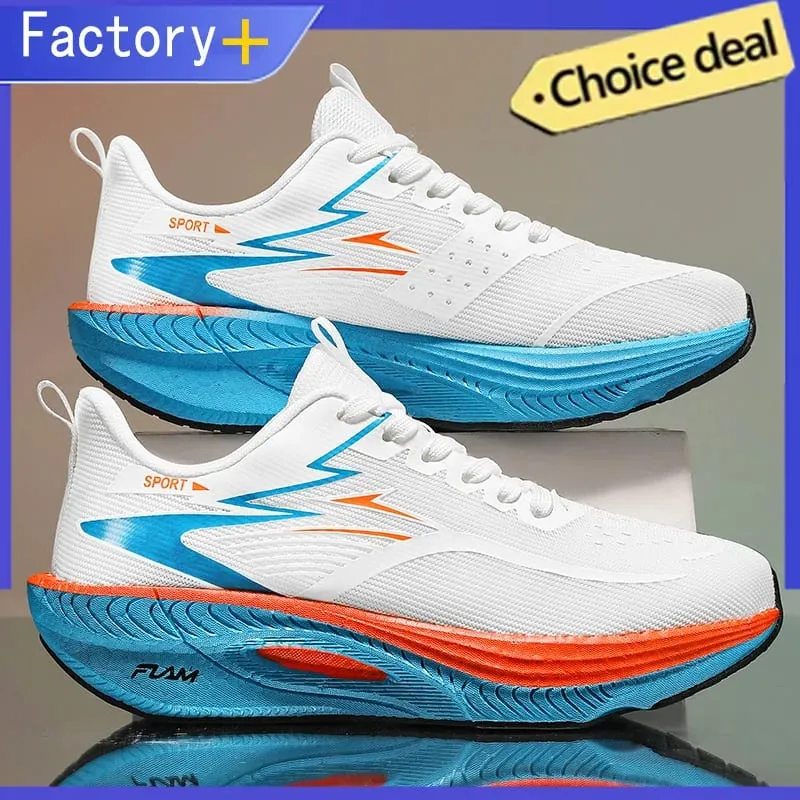
Let's talk about what's actually in it, because the build is where the surprise starts. The upper is a woven breathable mesh — the kind with visible perforations across the toe box and along the sides, so air moves through instead of pooling around your feet. Stitching around the heel counter and eyestay is tight and even, no loose threads on the pairs I've inspected. Inside there's a padded collar and a cushioned insole that's glued in but not cheaply — it has actual foam density to it. The midsole is where the carbon board sits, sandwiched between layers of EVA. Now, before anyone gets excited: this is a carbon *plate*, not a full carbon-fiber racing plate like you'd find in a marathon shoe costing ten times as much. It's a stiffening layer that gives the sole a springy, rolling feel when you push off. The outsole is rubber with a modest tread pattern — fine for pavement, packed trails, gym floors. It's a lightweight shoe overall, and you feel that the second you pick up the box.
The exact specs, since I know you're scrolling for them. Sizes run from 34 up to 39, which — and yes, I hear you — is a smaller range than a lot of men's shoes get. If you're a bigger guy, size up accordingly and check the conversion chart before ordering, because I don't want you guessing. The colorways we stock are listed right there on the product page, and honestly the photos do them justice. Price is $29.16, flat, no games. Weight-wise these come in light enough that you'll forget you're wearing them after about ten minutes, which is either a compliment to the design or a warning about the tread, depending on how you look at it.
So what do you actually do with these? Three real scenarios from my own week. First, my morning three-mile loop around the neighborhood — they're springy enough on asphalt that my calves feel worked but not beaten up, and the mesh keeps my feet from cooking even in July. Second, my partner wears them for twelve-hour shifts on concrete floors at the hospital, and she says the cushioning holds up better than the sneakers she paid triple for. Third — and this is the one that surprised me — I wore them on a weekend city trip, probably eight miles of walking between museums and lunch, and I had zero blisters and zero aching arches. They're not trail runners and they're not serious marathon race-day shoes despite the "marathon" wording in the listing. Treat them as fast-feeling everyday trainers and you'll be happy.
Using and caring for them is simple, but a couple of things matter. Break them in for a few days of short walks before you take them on anything long — that carbon board has a stiffness that softens up as the sole flexes. Don't machine wash them. Hand wash with cool water and mild soap, scrub the mesh gently with an old toothbrush, then air dry them away from direct sun and never in the dryer, because heat will warp the plate and break down the glue. Rotate them with another pair if you wear them daily, and they'll last considerably longer. Also, pull the insoles out to dry after sweaty runs — trapped moisture is what kills mesh shoes faster than mileage ever will.
Now the honest part. Pros: the price is absurd for what you get, the breathability is real, the carbon board gives a genuinely fun push-off, and they're light enough to forget about. Cons: the size run stops at 39, which locks out plenty of people, and that's a real limitation, not a nitpick. The tread is shallow, so wet pavement requires some caution. And the durability ceiling is what it is — I'd expect six to nine months of regular use before the midsole compresses and loses its pop. If you want a shoe for the next five years, this isn't it. If you want a comfortable, fast-feeling daily pair for under thirty bucks, it absolutely is.
Here's my take as someone who's watched a lot of budget shoes come and go. The design philosophy here is clever in a simple way: put the stiffening plate low in the midsole so it acts like a lever, roll the toe slightly upward, and keep the upper thin and ventilated. That combination reduces how much energy your foot wastes flexing the shoe on each step, which is why a cheap sneaker feels quicker than it has any right to. It suits people who walk or jog regularly on flat, hard surfaces and want a lightweight, breathable shoe without spending real money — students, shift workers, casual runners, travelers. It does not suit heavier runners needing maximum support, trail runners, or anyone above size 39. Within its lane, though, it's one of the better values we've carried this year, and I don't say that lightly.