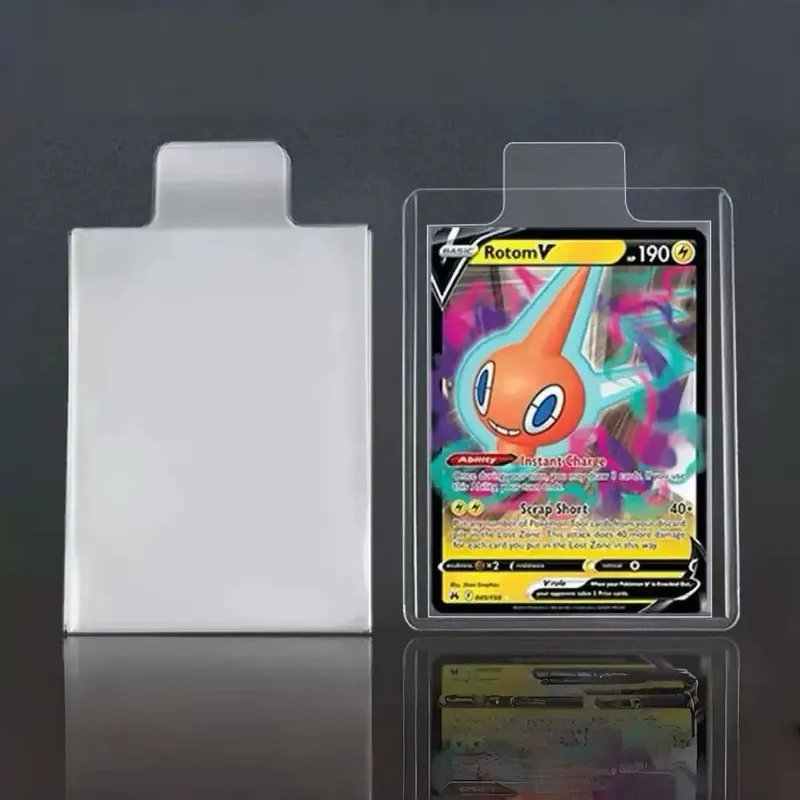
Let me tell you about one of those little items that doesn't look like much on the shelf but ends up being the thing people come back for. It's our 65x90mm card sleeves — a hundred of them in a pack, clear as glass, and priced at $11.99. I've handled a lot of sleeves over the years, and this batch has become a quiet favorite among the Pokemon crowd, the traders, and honestly, a fair number of parents who just want their kid's cards to survive the schoolyard.
First, the material. These are made from soft, non-acid transparent plastic — the kind that's flexible but not flimsy, with a slight give when you pinch it. The edges are heat-sealed, not glued, which matters more than people realize. Glued seams split after a few months of shuffling; heat-sealed ones hold. The surface is smooth on both sides with just enough texture to stop cards from sliding out when you tilt the binder. They're also PVC-free, so they won't slowly yellow your cards or leave that chemical film on foils that cheap sleeves sometimes do. In the hand, they feel closer to a decent penny sleeve than a rigid top-loader, but the thickness is noticeably better than the no-name bulk packs you find at discount stores.
Now the exact specs, because this is where people get tripped up. Each sleeve measures 65 by 90 millimeters — that's the standard size for Pokemon, Magic: The Gathering, and most Japanese TCGs. You get 100 pieces per pack, which covers a full 60-card deck plus sideboard and spares. The sleeves are transparent, so your card art and holo patterns show through fully; there's no tint, no logo, no matte back. Colors? The product page lists what's currently in stock — check there, because our supplier rotates stock and I don't want to promise a color we sold out of last week. Sizes are standard, meaning if you're sleeving Yu-Gi-Oh (smaller) or oversized cards, this isn't the pack for you. For Pokemon and similar, it's a perfect fit.
So what do people actually do with them? Three things, mostly. First, deck protection. A kid builds a 60-card deck, plays it at the kitchen table, shuffles it like a deck of playing cards, and within two weeks the corners are mush. Sleeve them and the cards survive months of that. Second, trading. When you're swapping cards at a local meetup, nobody wants to hand over a mint Charizard raw. Drop it in one of these first — it keeps fingerprints, thumb bends, and minor scratches off the face. Third, display and storage. I know a guy who sleeves his whole collection and stands them in a cheap cardboard box; the sleeves keep dust off and make the cards easier to flip through without touching the surfaces. Parents also use them for sports cards, and I've seen them used for homemade board game cards, which honestly works fine.
Using them is about as simple as it gets. Slide the card in from the top, open end down when you store it so dust settles away from the card face. For double-sleeving, put the card in a perfect-fit inner first, then this outer — it's snug but not a fight. Maintenance is minimal: wipe with a dry microfiber cloth if they get smudgy, keep them out of direct sun, and replace any sleeve that gets creased, because a bent sleeve can press a line into the card over time. Don't wash them with water or alcohol; it clouds the plastic. And don't overstuff a binder page — three cards in one pocket stretches the sleeve and that's how corners get dinged.
Pros, honestly: the price is right for a hundred, the clarity is excellent, they fit standard cards precisely, and the heat-sealed seams have held up in my own testing. They're also great for kids because a damaged sleeve is a two-cent problem, not a ruined card. Cons, and I'll be straight with you: these are not rigid. They will not stop a determined bend or a spilled drink. If you're storing a high-value card long-term, buy top-loaders or rigid holders instead. Also, some sleeves arrive slightly staticky and stick together when new — fan them out once and it settles. And the transparent back means no colored backing, so if you're playing in a tournament that requires opaque sleeves, these won't qualify.
Here's the design analysis, since I've watched these things for years. The 65x90 format with a soft, clear, PVC-free film works because it solves the main problem — contact damage — without adding bulk. A rigid holder protects better but turns a deck into a brick and ruins shuffle feel. A cheap thin sleeve disappears in a week. This sits in the useful middle: enough thickness to absorb handling and shuffling friction, thin enough that a 60-card deck still fits in a standard box. The heat-sealed edge is the quiet hero; that's what separates a sleeve that lasts a season from one that splits in a month. Who does it suit best? Kids and teens starting a collection, casual players who shuffle a lot, traders who want a cheap layer of protection on mid-value cards, and anyone organizing bulk. It's not for the investor with a five-figure card in a safe. For everyone else, SKU P3256809920597499 at $11.99 is a sensible buy.